A school newsletter has a simple job: help families understand what is happening in school and what they need to know next.
That sounds straightforward enough, but anyone who has ever put a school newsletter together knows how quickly it can become a dumping ground for dates, reminders, trip updates, PTA requests, club information, forms…
Your newsletter might contain lots of important information, but that doesn’t always mean it feels easy or inviting for parents to read.
The best school newsletters are usually clear, useful and easy to scan. Here are some practical ways to make yours more engaging for families.
1. Mix whole-school updates with class and year group news
Whole-school news matters. Parents need to know about school events, policy updates, fundraising, uniform reminders and everything else that affects the wider school community.
But if every update is aimed at everyone, the newsletter can start to feel a bit distant.
Try to include news from specific classes, year groups or parts of the school too. That could be a Year 3 trip to the museum, a Reception forest school session, a Year 6 sports tournament, a library project or a brilliant piece of work from an art project.
These stories help parents feel more connected to what their own children are experiencing day to day. They make the newsletter feel less like an admin bulletin and more like a window into school life.
2. Make action items impossible to miss
If parents need to do something, make that really clear.
A newsletter might include a reminder to book parents’ evening appointments, complete a survey, buy tickets, return a consent form or sign up for a school trip. If those actions are buried halfway through a paragraph, they are easy to miss.
A good rule of thumb is this: if you need a parent to take action, give that action its own space.
Use a clear heading, a short explanation and a prominent link or button. Instead of vague link text like “click here”, use something specific like Book parents’ evening and if possible, give a deadline so readers can set themselves a reminder if they don’t have time to do it right now. Provide an actual date rather than something more vague like “the end of next week”.
And while we’re on that subject…
3. Help parents keep track of important dates
Schools share a lot of dates, and parents have a lot to remember.
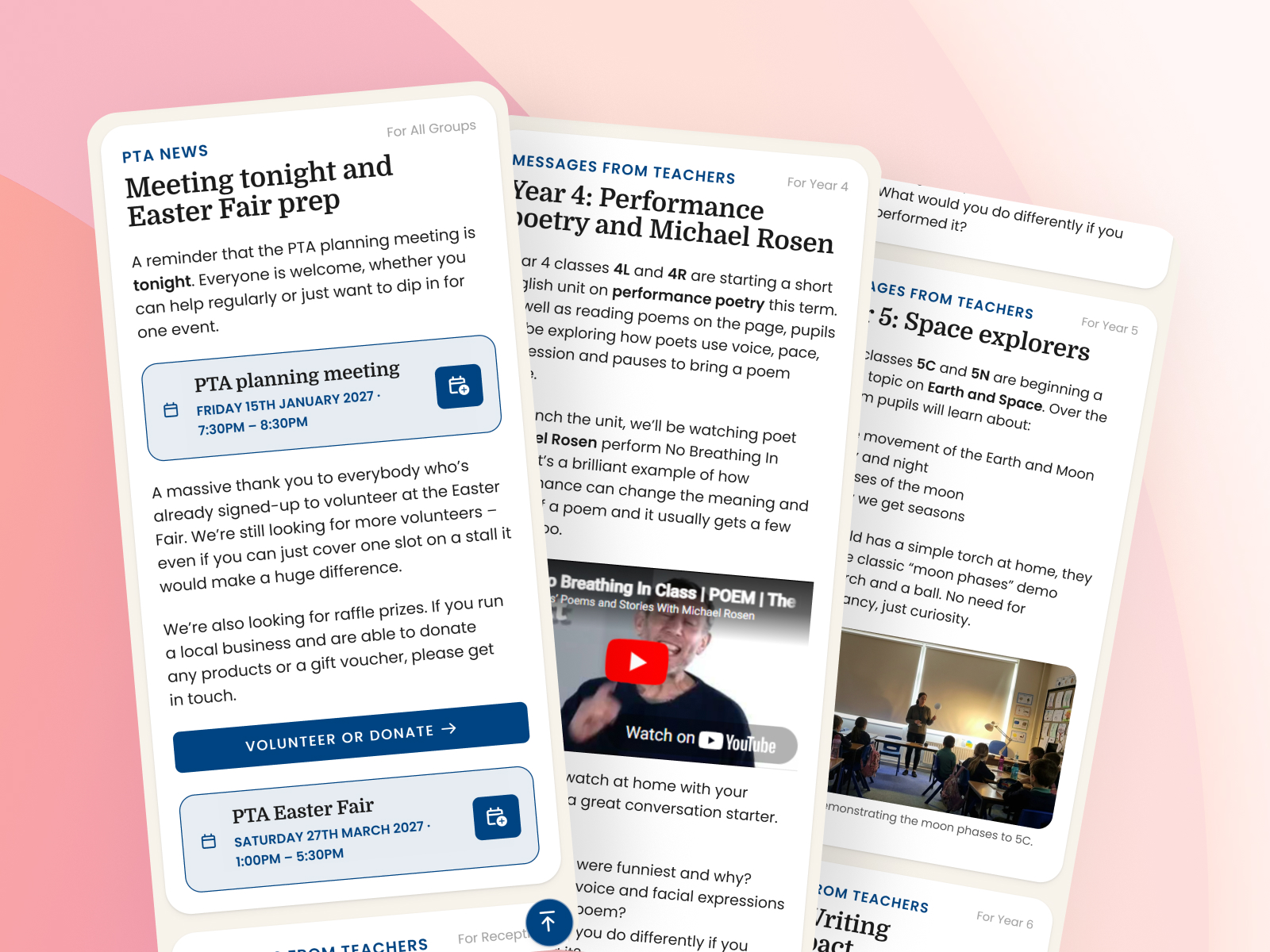
If there is a trip, deadline, performance, non-uniform day, PTA event, sports day or parents’ evening, do not leave it hidden inside a long block of text. Make diary dates stand out with a consistent format that includes the date, time, location and any action needed.
Even better, make it easy for parents to add events to their own calendar. That small step turns the newsletter from something parents have to remember to check again into something that actively helps them stay organised.
4. Use photos and videos, but keep the design grown-up
Photos are one of the easiest ways to make a school newsletter more engaging. They show parents what their children have been doing, bring school events to life and help celebrate the work happening across the school.
Videos can be useful too, especially for performances, assemblies, project showcases or messages from school leadership.
But try not to over-design the newsletter. It can be tempting to add clip art, novelty fonts, decorative graphics and colourful borders, especially when creating something for a school. The trouble is that the main audience is parents and carers, not pupils.
A school newsletter should feel warm and friendly, but still clear and easy to read. Good photos, short stories and well-structured information will usually do far more for engagement than lots of decoration.
5. Gather stories from across the school community
A newsletter is more interesting when it reflects the whole school, not just the office.
Try to build a simple routine for gathering updates from school leadership, teachers, year group teams, the PTA, governors, the library, clubs and even pupils themselves.
This does not mean every edition needs something from everyone. That would quickly become unmanageable. But a regular flow of varied contributions helps the newsletter feel more alive and spreads the job of creating content.
6. Keep repeated reminders under control
Some notices need repeating. Parents often need more than one reminder about deadlines, events or ongoing policies. The problem is that when the same items appear week after week, regular readers can start to skim past them. Once that happens, genuinely important updates can get missed too.
Try to separate repeated reminders from fresh news. You might have a regular Notices or Reminders section near the end of the newsletter, while keeping new stories and urgent updates nearer the top.
It can also help to update the wording as the deadline gets closer. “Sports day is next Friday” is more useful than repeating the same paragraph for the third week in a row.
7. Write for scanning, not careful reading
Let’s be honest: Most parents won’t read every word of every newsletter. That doesn’t mean they do not care. It just means they are busy.
They might be reading on their phone while making dinner, waiting outside a club, checking messages at work or trying to find one specific thing before the school run.
Make that easier for them. Use clear headings, keep paragraphs short and put the most important information near the start of each item. A good school newsletter should work for the parent who reads the whole thing properly and the parent who needs to quickly find the one thing that matters today.
Better newsletters are not about making more work
Creating a better school newsletter does not mean making it longer, fancier or more complicated.
Usually, it means doing the basics really well: sharing a good mix of school-wide and family-relevant news, making important actions clear, helping parents keep track of dates, using photos thoughtfully, gathering updates from across the school and making everything easy to scan on a phone.
That is what makes a newsletter feel worth opening.
A simpler way to create better school newsletters
Ecko was built around a simple idea: school newsletters should be easier for schools to create and easier for parents to read.
Instead of designing each newsletter as a document or wrestling with a template, you create updates as individual stories and pull them into an edition. Ecko handles the layout automatically, so your team can focus on the content rather than nudging boxes around a page.
It also helps with many of the things covered in this article, including clear stories, rich content, diary dates, calendar links, group filters, recurring content and mobile-friendly newsletters that work beautifully on phones, tablets and desktops.
It is not about making school newsletters flashy. It is about making them work better.
Better for staff. Better for families. And much more likely to be read.